Polycronia is a rebellion against the ‘dusty’ image of traditional opera. It’s an opera cybera that bridges the gap between orchestral tradition and pop culture, delivered entirely through a web player and high-quality download. With a libretto that mixes original storytelling with Kleist’s Penthesilea and a soundtrack ranging from avantgarde orchestra to Electronica and Math Rock, it’s a multi-layered, interactive drama that brings the operatic stage directly into the digital world.
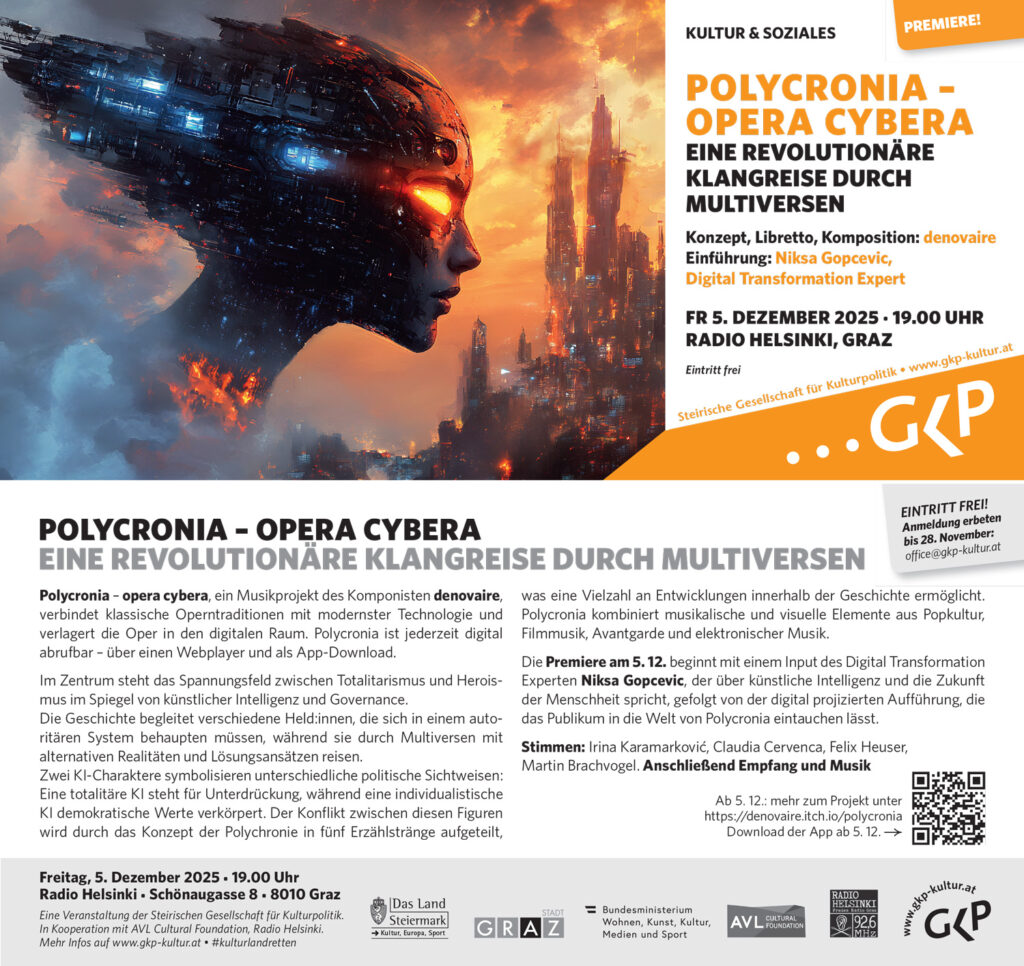
Following the great success of Transcendence and the continued interest in innovative forms of opera, composer Denovaire presents his latest work: Polycronia – opera cybera. This avant-garde music project continues the exploration of new narrative and sonic dimensions, relocating opera into the digital realm.
Polycronia is available both via web player and as an app download, offering an immersive experience that merges classical operatic traditions with cutting-edge technology. The story unfolds through multiple characters, performed by renowned singers. The music combines contemporary orchestral sounds with electronic elements, creating a unique sonic landscape.
At the core of Polycronia lies the tension between totalitarianism and heroism, reflected through the lenses of artificial intelligence and governance. The narrative follows heroes who must assert themselves within an authoritarian system while traveling through multiple universes—across alternate realities and divergent solutions. Themes such as transhumanism, swarm intelligence, artificial intelligence, total control, and the use of devastating weapons take center stage. The work raises fundamental questions about the distinction between biological and artificial life, the conflict between scientific ethics and elitism, and the possibilities of utopian and dystopian futures.
As two of the main characters are AIs, their contrasting political orientations are brought to light: on one side, a totalitarian regime that suppresses individuality but has eradicated hunger and war; on the other, a highly individualistic entity with democratic and enlightened ideals. These two are not merely opposed—they are bound to one another. Following the principle of “polychronos”—the coexistence of multiple times—the conflict is split into five narrative threads, opening a field of possibilities.
Musically, Polycronia presents itself as a captivating spectacle with pop-cultural overtones. Stylistically, it intertwines influences from comic strips, science fiction, and cyberpunk with experimental and progressive soundscapes. Inspired by film music, avant-garde orchestral works, heavy metal, and electronic music, it creates an intense and singular listening experience. The texts, written by the composer, include quotations from Kleist’s Penthesilea.
Concept, libretto, and composition: Denovaire
Supported by: GKP – Styrian Society for Cultural Policy, BMWKMS, Province of Styria, and the City of Graz and the avl Cultural Foundation.
Denovaire
Mag. art. Deno Kaufmann
Maygasse 24, 8010 Graz
+43 650 939 2424
www.denovaire.at
office@denovaire.at
The composer offers specialized lectures and academic talks on the digital cyberpunk opera POLYCRONIA, alongside deep dives into the innovative workflows behind its creation. These sessions are tailored for young composers, music theorists, media artists, and advanced school students. The lecture can be held in English or German language.
Duration: Flexible formats ranging from 45 to 120 minutes.
Technical Setup: Lectures can be seamlessly combined with a full-length listening or viewing session (Opera duration: approx. 90 minutes) utilizing a projector (Beamer) and PA system.
Core Topics: Hybrid workflows, media composition, digital opera production, and modern music theory in multimedia art.
Interactive Student Engagement: Each session is highly interactive and adaptable to the students’ current state of work. The composer offers direct feedback, references the students’ own portfolios or projects, and tailors the discussion to align with their specific academic needs and artistic interests.
The lecture program is structured modularly, allowing the following chapters to be individually selected, combined, or adapted to perfectly match the focus of the audience, whether the emphasis is on cutting-edge production technology, contemporary music theory, or an engaging introduction for students.
Bridge Theory and Practice: Gain firsthand insight into how academic training and music theory evolve into a viable, real-world artistic career.
Demystify the Creative Process: Understand the mechanics of high-level artistic decision-making, from dealing with doubts to choosing specific composition techniques.
Expand Creative Horizons: Discover how to integrate cutting-edge tools (AI, hybrid workflows, custom instruments) to push the boundaries of your own creative practice.
Inside a Working Artist’s Studio: Learn through concrete, real-world examples how a large-scale multimedia project is actually produced, managed, and delivered.
Professional Mentorship & Networking: Engage in a professional dialogue, receive direct feedback on your current state of work, and connect with a working peer in the industry.
Rebellion veterans EnY and Julya are facing their final stand: in a desperate battle against the Artificial Intelligence subjugating humanity, they aim to achieve a decisive breakthrough with the help of the last free humans. Their plan is to harness the technology of a secret scientific cult to hurl the “Mainframe”—the heart of the AI—back into the digital Stone Age, finally liberating mankind.
But nothing goes as planned. The narrative fractures into five parallel threads—offering five possible endings. Bombs fail or trigger unexpected consequences, moral convictions waver, heroism collides with political intrigue, and the supposedly “evil” AI reveals surprisingly ambivalent traits.
polycronia is an opera cybera—a virtual opera at the intersection of New Music, experimental soundscapes, Electronic Progressive Metal, and audio drama. Featuring extraordinary vocalists and a gripping, multi-layered soundtrack, it unfolds as a musical-dramatic experience far beyond conventional genre boundaries. The libretto, written by the composer himself, blends original text with fragments from Heinrich von Kleist’s Penthesilea.